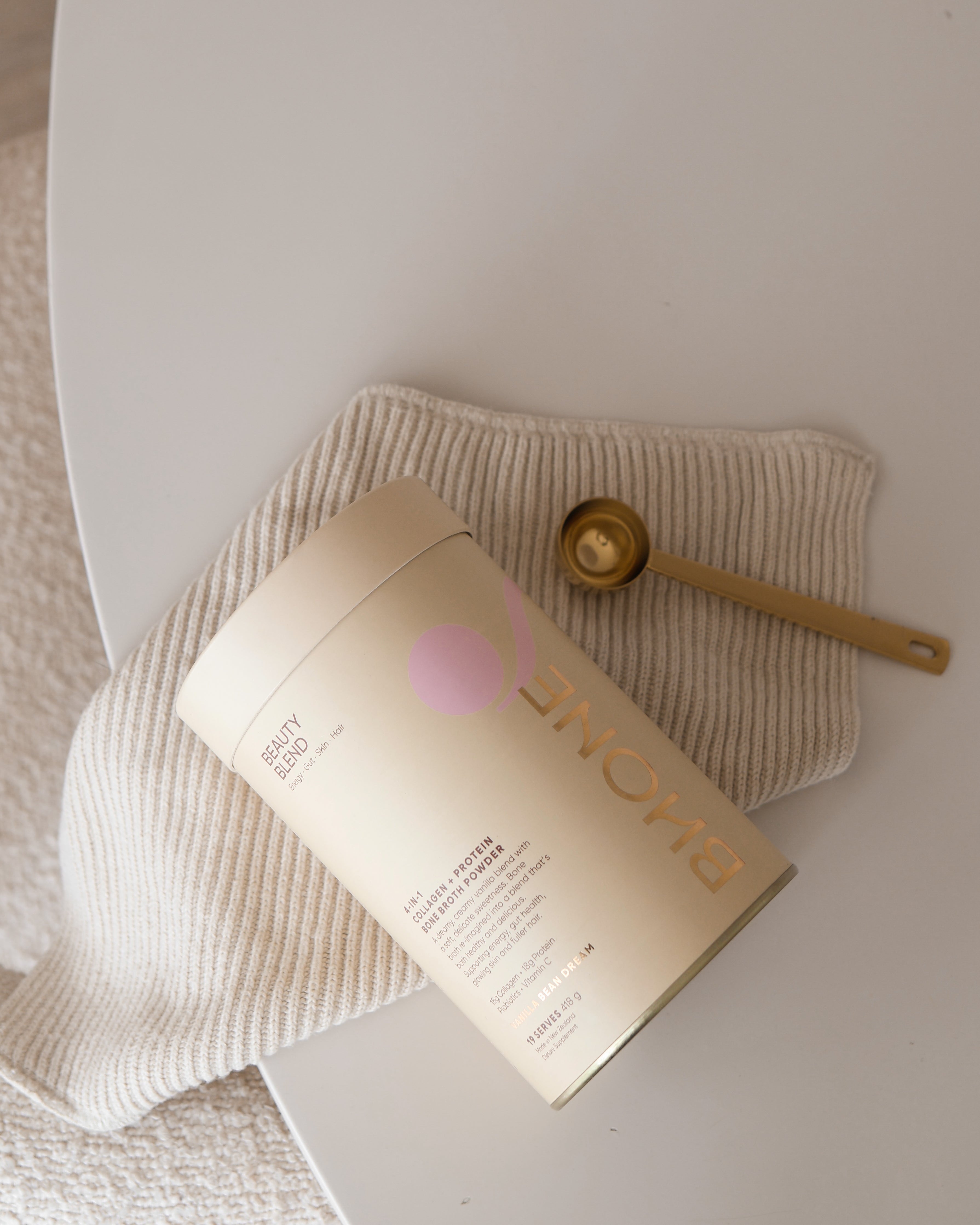
Bone Broth vs Collagen supplements: What's Actually in the Scoop
You are standing in front of the shelf with a tub of collagen peptides in one hand and a bone broth powder in the other, and both are promising you the same things. Skin. Hair. Nails. Joints. Gut.
We obviously sit on the bone broth side. But here is the honest comparison.
What is collagen?
Collagen is the structural protein that holds you together. It makes up roughly 30 percent of all the protein in your body and it is the main protein in your skin, your bones, your tendons and the lining of your gut.
Your body makes its own. Production starts to slow from around your thirties, which is the reason this entire category exists.
Collagen peptides are collagen that has been broken down into smaller pieces, a process called hydrolysing. They are made almost entirely from animal hides and skins.
What is bone broth?
Bone broth is what you get when you simmer bones, joints and cartilage slowly for a long time, usually twelve to twenty four hours, until the collagen and the nutrients are drawn out into the liquid. It is then dried into a powder.
What do they have in common?
Both give you collagen, and it is largely the same collagen.
The amino acids doing the work are the same ones in both: glycine, proline, hydroxyproline, arginine. Anyone telling you that one of these delivers real collagen and the other does not is selling you something.
So the difference is not the collagen. It is everything that comes with it.
Where does each one come from?
Collagen peptides come from hides and skins. Hide gives you collagen, and that is the design.
Bone broth comes from bones, joints and cartilage. Bones and joints give you collagen plus everything that lives alongside collagen in a joint.
That is the whole difference in one line, and it is worth spelling out what "everything else" actually means.
The benefits of bone broth
A scoop of collagen peptides contains collagen. A scoop of bone broth contains collagen and the compounds that were in the joint next to it.
Joint and cartilage comfort. Glucosamine and chondroitin are the compounds people buy a separate joint supplement for. In bone broth they arrive naturally, in the same scoop.
Plumper, more hydrated skin. Hyaluronic acid, the ingredient the skincare aisle is built on, sits naturally in connective tissue and comes out of the bones with everything else.
Hydration and bone support. Calcium, magnesium, potassium and phosphorus are drawn out of the bones during simmering. Minerals and electrolytes, from the source. Bone, supporting bone.
Repair for skin, hair and nails. A broader amino acid spread than collagen alone, because you are extracting from the whole structure rather than one isolated part of it. More of the building blocks your body uses to repair and renew.
Gut support. Glycine and the gelatin drawn from connective tissue are the reason bone broth has been the thing people reach for when their stomach is unsettled, for as long as there have been grandmothers.
Far less processing. Bones, water, time. That is the method.
Same one scoop. Considerably more in it.
How is each one made?
Collagen peptides go through a genuine industrial process. The hides are washed, soaked in an alkaline or acid solution, boiled, evaporated, concentrated, dried and milled. This is what makes the powder tasteless and cold-water soluble.
It is also what makes it ultra-processed, and that is worth thinking about. Several of those steps exist specifically to strip out everything that is not collagen, which is exactly why the minerals, the glucosamine and the chondroitin are not in the tub. And the further a powder travels from its original food, the more likely it is that flavour, sweetness and texture have to be added back in at the end. A short ingredient list is hard to keep when you have processed the food out of the food.
Bone broth is simmered low and slow, then dried.
It is worth asking of any powder how hot it got. Heat is the fast, cheap way to dry something, and it takes the nutrition and the flavour with it. A good bone broth powder is dried gently enough to keep the goodness in, which is why it still tastes like something.
What collagen peptides do better
- They dissolve better in cold water. Straight into a cold glass, no shaker.
- They are usually higher in collagen per scoop, because nothing else is taking up room.
- They are simple. One ingredient, one job, nothing to research.
Your body cannot make collagen without vitamin C
This is the part almost nobody mentions.
Vitamin C is a required cofactor in collagen synthesis. Without it, your body cannot complete the process of building collagen. This is not a wellness talking point, it is basic nutritional biochemistry.
So if you are taking a collagen supplement to support your body's own collagen production, and there is no vitamin C in the tub or anywhere else in your morning, you are supplying the raw material and leaving out the tool that puts it to work.
Most collagen products do not include it. It is worth checking yours.
What to look for when choosing bone broth or collagen powder
This list applies to both.
- Where the animals were raised. New Zealand and Australia are usually held up as the gold standard for farming and traceability. Wherever you choose, make sure it comes from somewhere with standards worth trusting. A product that will not tell you its country of origin is telling you something.
- Grass fed, hormone free and antibiotic free.
- Heavy metal testing. Powdered supplements concentrate whatever was in the source material, and independent testing has repeatedly found protein powders exceeding regulatory limits for heavy metals. Chocolate flavours have historically been among the worst affected.
- A short ingredient list. Bone broth, a flavour, a sweetener you recognise. If you are reading through gums, fillers and a paragraph of unnamed flavourings, treat that as a warning.
- Check the sodium. High sodium in a broth powder is often salt doing the job that quality should have done.
- Watch the word "concentrate". A product labelled broth concentrate is not necessarily broth.
Where Bhone sits
It starts with the farming. Our cattle are pasture raised on New Zealand grass, and we only work with suppliers who can trace back to the origins and who value ESG processes.
From there the broth is gently dried rather than blasted with heat, so the nutrition stays in the tub. Then we add natural flavours, because something you look forward to is something you actually keep drinking.
- 100 percent New Zealand grass-fed bone broth
- Hormone free, antibiotic free
- Tested for heavy metals
- All nine essential amino acids
- No refined sugar
- No GMOs
- No artificial colours or flavours
- Gluten free, with dairy free options
Alongside the broth there is vitamin C, so the collagen has what it needs to be put to work, and a synbiotic blend of pre, pro and postbiotics for gut support.
Four supplements, one cup. Simple, and delicious.
The final word
Collagen peptides are a clean, simple, single-purpose supplement.
Bone broth is the food that collagen was isolated from in the first place. You get the collagen, but you get a lot of other benefits too.
Frequently asked questions
Is bone broth better than collagen powder? It depends on what you are after. Bone broth gives you collagen plus the full spectrum of amino acids, electrolytes and the compounds that support gut and joint health, in a form that has been through far less processing. Collagen peptides give you more collagen per scoop, in a form that dissolves in cold water and is often tasteless. One is the whole food, the other is the isolated part.
Does bone broth powder contain collagen? Yes. Collagen is the main protein drawn out of the bones and connective tissue during simmering. A quality bone broth powder will state its collagen content per serve.
Can I take bone broth and collagen together? You can, though for most people it is duplication. Both are supplying collagen. If you already take a bone broth with a stated collagen content, adding a peptide powder mostly adds cost.
How much collagen do I need a day? There is no settled consensus, and products on the market range widely. Most research on skin and joint outcomes has used somewhere between 2.5g and 15g a day.