The 4-in-1 ritual: What collagen, protein, vitamin C and probiotics actually do together
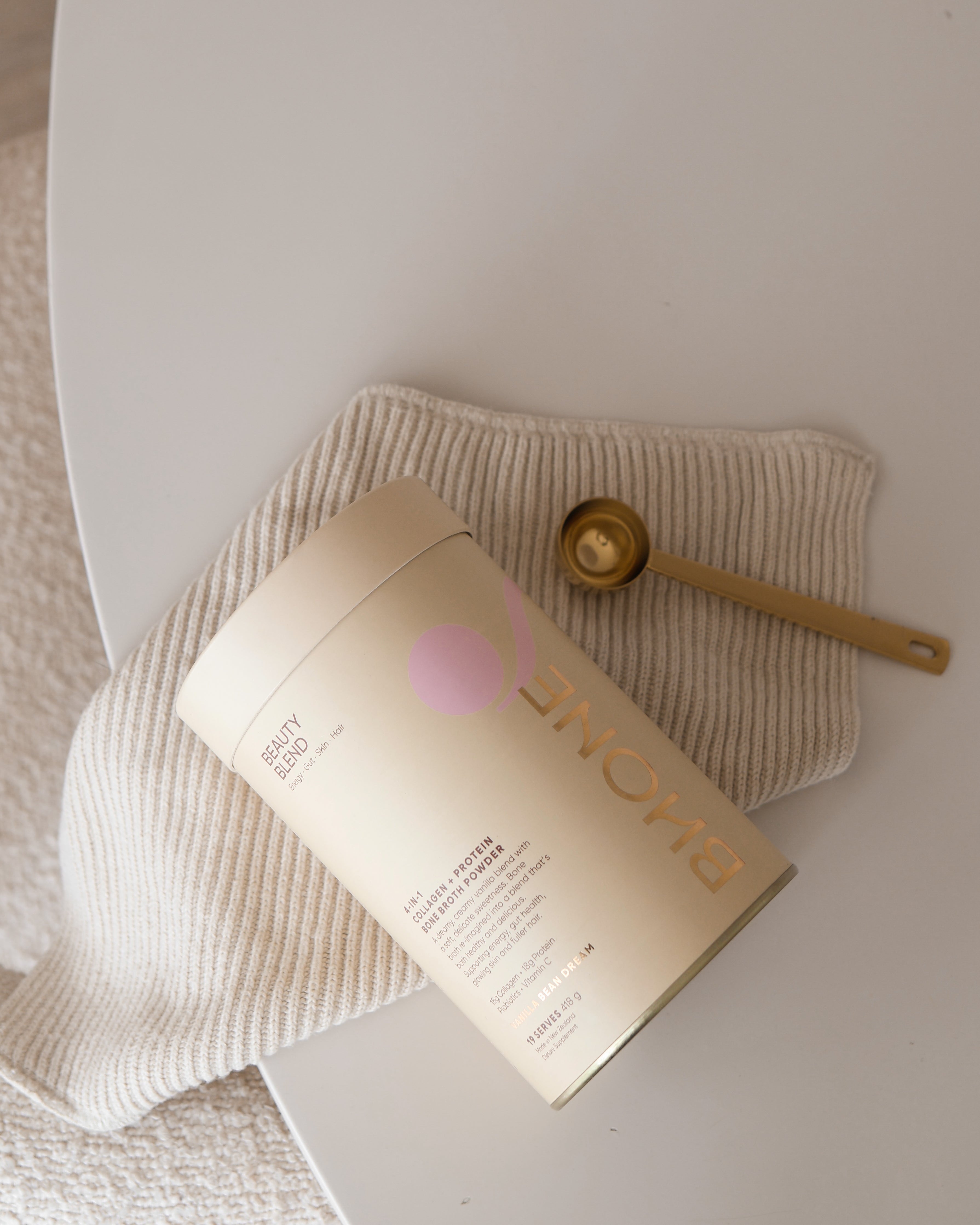
The Morning Supplement Routine, Simplified
There's a version of the morning supplement routine that involves a collagen sachet, a protein shake, a vitamin C tablet and a probiotic capsule. Four separate things, four separate jobs, four separate products to remember.
I did that version for years.
What I didn't understand then, and what research has started to map more clearly, is that these four aren't just separate ingredients that happen to be good for you. They're interdependent. What you take matters less than whether you're taking the right things alongside each other.
What each one does on its own
Collagen is the most abundant protein in the body. It's the scaffolding for skin, joints, gut lining and connective tissue. Your body produces it naturally, but production slows from your mid-twenties and drops more significantly from perimenopause onward.
Bone broth protein is a wholefood source, meaning it comes from slow-simmered bones, not a lab, and it's rich in collagen and three key amino acids: glycine, proline and glutamine. Glutamine feeds the cells that line your gut. Glycine supports sleep and helps calm inflammation. They do quiet, structural work that most protein powders simply don't.
Vitamin C gets filed under "immune support" and mostly forgotten. But research is clear that it's a required co-factor for collagen synthesis. Your body cannot produce collagen without it. Not "it helps." Cannot. Taking collagen without enough vitamin C is a bit like buying every ingredient for a recipe and forgetting to turn the oven on. Everything's there. Nothing is actually getting made. Most collagen products don't include it, which has always seemed like a significant oversight to me.
Probiotics introduce beneficial bacteria to the gut. But here's the thing most brands don't tell you — most probiotic strains don't survive the journey. Stomach acid kills them before they get anywhere near where they need to be. You swallow them, and that's about as far as they get.
The strain in Bhone is different. Bacillus subtilis is a spore-forming probiotic, which means it has a protective coating that lets it survive the trip through your stomach acid and actually arrive in your gut alive and intact. That's not marketing language. That's just how the biology works. A probiotic that doesn't reach your gut can't do anything for it.
Why they need each other
This is the part that changed how I thought about all of it.
Collagen without vitamin C is only partially useful. Research shows collagen synthesis requires vitamin C at every stage of the process. If you're low in vitamin C, you're essentially getting the raw materials without the means to build with them.
Probiotics without prebiotics are limited. Think of it like inviting guests to dinner with nothing in the fridge. Beneficial bacteria need something to feed on. The prebiotic fibre in Bhone (chicory inulin and maize fibre) is there specifically for this reason. Most probiotic products skip it entirely.
Probiotics without gut lining support miss a step too. The gut lining needs glutamine to stay strong and intact. A compromised gut lining means beneficial bacteria have less to work with. The bone broth amino acids and the probiotic are doing connected jobs, not separate ones.
And protein without gut health is absorbed less efficiently. If your gut lining is compromised, nutrient absorption goes with it. Most single-ingredient supplements don't account for this connection.
Before I made Bhone, I had a full shelf
Before Bhone, my supplement shelf was a headache. Full of products with ingredients I'd never heard of. Half the time I forgot to take them. The other half I felt anxious about whether I was even taking the right things, in the right order, at the right time.
Stripping back and getting as close to the source as possible has been my biggest lesson. Wholefood sources with scientific evidence behind them. Not the latest craze. Not more products. Less, but of the right thing.
That's what I wanted to build. One wholefood habit with real research behind every ingredient, instead of four things on a shelf I'd lose track of by Tuesday.
Health doesn't have to be complicated.
What one serving actually looks like
One scoop of Bhone in warm milk or water. Or add it to smoothies, shakes, oats (anything really). That's it.
What I can tell you is that one serve covers the collagen and protein, the vitamin C, the probiotic and the prebiotic fibre. All in one drink you can genuinely want to make every morning.
Consistency is the variable that actually matters here. Research on collagen supplementation consistently shows results at the 8 to 12 week mark. Probiotics need sustained daily use to meaningfully shift the gut microbiome. A two-minute warm drink you look forward to is more likely to last than a handful of capsules you forget about by Wednesday.
The Bhone benefits page has the full breakdown of each ingredient and the evidence behind it. And if you want to go deeper on the gut side, the Bhone Belly page is worth a read.
Why most products don't do this
Single-ingredient supplements are easier to market. "Collagen for skin" is a clean message. "Four co-dependent nutrients that support gut health, collagen synthesis and skin from the inside" is harder to put on a label.
But the body doesn't work in single ingredients. It works in systems. The collagen-vitamin C dependency and the probiotic-prebiotic relationship aren't marketing angles. They work together because that's how the biology actually functions.
I'm currently pregnant again. And once again I'm reminded of how important it is to feel secure about what you're putting in your body. Sometimes that's not more. It's less, but of the right thing. Back to the source. Back to wholefoods. Back to ingredients with research behind them.
It doesn't have to be the latest craze. It just has to work.
Renei x
References
- DePhillipo, N.N. et al. (2018). Efficacy of vitamin C supplementation on collagen synthesis and oxidative stress after musculoskeletal injuries. Orthopaedic Journal of Sports Medicine.
- Rao, R. & Samak, G. (2012). Role of glutamine in protection of intestinal epithelial tight junctions. Journal of Epithelial Biology and Pharmacology.
- Cutting, S.M. (2011). Bacillus probiotics. Food Microbiology.
- Shoaib, M. et al. (2016). Inulin: properties, health benefits and food applications. Carbohydrate Polymers.
- Proksch, E. et al. (2014). Oral supplementation of specific collagen peptides has beneficial effects on human skin physiology. Skin Pharmacology and Physiology.